Showing posts with label #eatingdisorderrecovery #diabulimia #Bulimia #Anorexia #EDRecoveryInspiration #BodyImageEmpowerment #diabetes #emotionaleating #bingeeating #weightissues #weightloss #fitness. Show all posts

Friday, June 13, 2014

Photoshop Cops, Enablers, or Superheroes?


Representatives Ileana Ros-Lehtinen(R., Fla.) and Lois Capps (D., Calif.) have, at the urging of reformed adman SethMatlins (D., formerly of Creative Artists Agency, Rock the Vote, etc.), offered up avery silly bill to empower the federal government to censor advertising on the theory that the overuse of photo-editing software causes anorexia and other eating disorders. The world being full of stupid people, there is an emotionally incontinent for-the-children petition demanding that the Federal Trade Commission implement this censorship, on top of Mr. Matlins’s earlier demand that advertising in which images have been altered — which is to say, advertising — be labeled to alert beef-witted Americans to the fact of that alteration.
Anorexia nervosa is a terrible condition that is not caused by Cosmopolitan magazine. The most significant risk factor for anorexia is genetic composition, not photo composition. While the research on the matter is far from settled, anorexia appears to be associated with a malfunction involving the EPHX2 gene, which, among other things, affects the metabolism of cholesterol and is associated with familial hypercholesterolemia. This points to a possible explanation of the counterintuitive fact that anorexics tend to have high cholesterol despite their restricted diets. Professor Cynthia M. Bulik of the University of North Carolina at Chapel Hill medical school (the occupant of the nation’s only endowed chair dedicated to the study of eating disorders) examined data from the Swedish Twin Registry (a very large sample population — nearly 32,000 individuals) and found that incidences of anorexia were much more strongly correlated in identical twins than in fraternal twins, suggesting a genetic component. Her analysis of the data suggests that genetic factors account for the majority of anorexia risk. “Fifty-six percent heritability,” she wrote, “that’s a fairly large contribution of genes.” Her research indicated that the development of anorexia later in life was strongly associated with early-manifesting neuroticism.
Research on the influence of environmental and cultural factors, including media exposure, is mixed, and much of it is ideologically shaped and interpreted. It is distorted in two common ways: The first is by lumping serious eating disorders such as anorexia and bulimia in with less serious episodes of disordered eating, or with simple dissatisfaction with the appearance of one’s body, and treating the aggregate as a unified pathology — rather like treating chronic alcoholism and short-term collegiate binge drinking as if they were the same phenomenon. The second distortion comes from inadequately dealing with — or flatly refusing to account for — the fact that people who are suffering from a disordered obsession with body image seek out media that affirm their ideals or that provide information about diet and weight-loss strategies. Reading diet articles does not make you anorexic, but being anorexic attracts you to diet articles. Some researchers believe this to be a circular phenomenon — the media-consumption body contributing to and resulting from the disorder — and perhaps it is, but the inconsistency of findings, the elusiveness of the mechanism of causality, and the prominence of relatively straightforward biological factors together suggest that the media-oriented explanation of anorexia is yet another in a long line of feminism-derived ideological assaults on reality, which have done so much harm to so many fields of social research.
I have no doubt that Mr. Matlins and his congressional patrons are acting with the very best of intentions, or at least believe themselves to be, but the attack on media beauty standards is largely a lamentably exhibitionist act of moral theater. Setting aside the obvious First Amendment issues, it might have occurred to Mr. Matlins, and to Representatives Ros-Lehtinen and Capps, that in an age of wall-to-wall pornography — including the distasteful subgenre of anorexic-centered pornography — asking a panel of kommissars down at the FTC to step on Lululemon ads in the service of a wobbly theory about the causes of eating disorders is probably going to have negligible effect. There is more to culture than advertisements, and unless we are ready to start banning everything from Angelina Jolie’s cheekbone extensions in Maleficentto breast augmentation, we will continue to confront images of human beings that are altered in the direction of some unknown aesthetic ideal.

That ideal, of course, is the real target here. Among the bouquet of crackpot ideas that have been bundled together under the heading “feminism” is the belief that beauty standards are a sort of conspiracy against women, used to keep them from making economic and political progress. Like the media-oriented analysis of eating disorders, this ignores a great deal of scientific research arguing that beauty standards, in their role as proxies for reproductive value, are more biologically evolved than “socially constructed,” as the insipid standard phrase has it. The world is of course a gorgeous mosaic of cultures, and 90-year-olds are hot in none of them. These things do not happen by accident. If we are in fact concerned about anorexia rather than about feminist metaphysics, then we’d probably do better to spend our time researching the genetics of cholesterol metabolism than measuring thigh gaps in Gaultier advertisements.

It is difficult to know what to make of a culture in which the federal government subsidizes sex-change operations while forbidding the alteration of photographs, but it is remarkable that the political tendency that insists on the depiction of “real women” in fashion advertising also, in other domains, defines “real women” to include people with functional penises and testicles used for sexual intercourse resulting in the occasional pregnancy. “Humankind,” as T. S. Eliot observed, “cannot bear very much reality.”

— Kevin D. Williamson is National Review’s roving correspondent and the author ofThe End Is Near and It’s Going to Be Awesome.


Thursday, June 12, 2014

How Families Deal with an Eating Disorder

I’ve seen hundreds of people get “dropped off” at treatment and watched their loved ones walk away, almost in worse shape than the new admit. I have often wondered who that moment is harder for. For the new admit, its realizing you’re in treatment, adjusting to new schedules, faces, etc. For the loved one, you are walking away, letting go and hoping for the best. When does that hope for the best turn into relief that for the next 30 days (god willing with insurance), you can regain some level of autonomy and breathe just a little deeper?

If you are reading this and thinking how selfish I must be for wanting to breathe a little deeper, I hope you never find yourself in a situation where you would understand where I am coming from. With that being said. It made me think about what this child’s parents would feel. They did everything “right,” they said the right things, monitored media influence, and yet their 9-year-old daughter ended up malnourished and 50 lbs.

The parents said, “We soon learned that nothing about an eating disorder was rational.” I think this is the hardest part for loved ones. The disease gets so good at mimicking what their new host used to be like and tricking on lookers into seeing “glimpses of the old you” truly invoking a false sense of hope. The more of these episodes there are is a good indicator that the person is being pulled further towards their disease. It’s usually not that long after the “exorcist” version comes to light, and you are met with a whole new slue of feelings, and horror.

I usually meet people in the real pits of their disease, so when I start learning who they actually are it’s incredible to see the transformation. I had a mother say something that has never really left me. “I know my daughter is a monster right now, but just know she is my monster and I love her.”

Before then I would have never thought to have the words “monster” and “love” in the same sentence. As I helped the daughter unpack I witnessed first hand the “monster” her mother had just warned me about. Up until this point I thought monster was a bit harsh, but after experiencing it the word monster really hit the nail on the head. As I got to know the “monster” the more I saw the young lady, I knew the monster and what it was capable of. I lived the monster. I at one point was the monster.

It was a real learning opportunity for me because it changed my whole perspective. Maybe because I was introduced to both her disease and the person she was outside of it at the same time. I don’t know why but those words have always stayed with me, and reminds me that no matter how “ugly” someone’s disease is they are someone’s “monster” and are loved.

Sunday, June 8, 2014

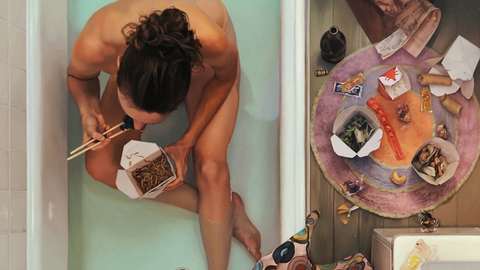
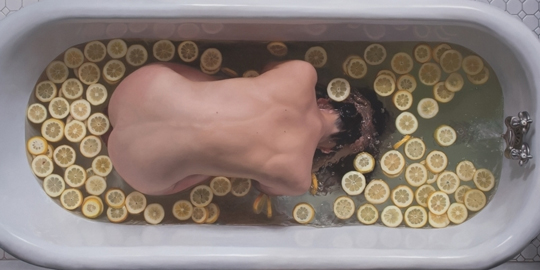
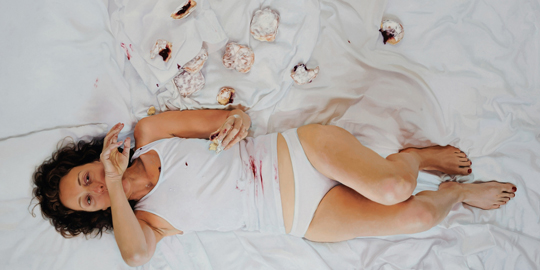
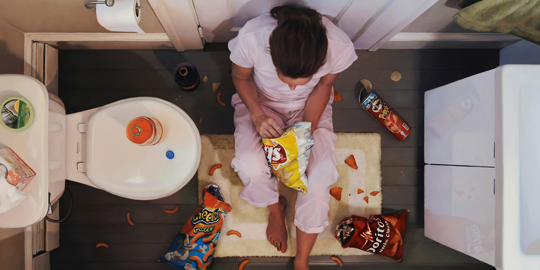
Realistic self-portraits reveal secret binge eating

The art of bingeing: The images are all set in private places - including the bathroom - as in the image above. Photo / Lee Price

By Naomi Greenaway

An American artist has exposed her most private moments in a series of self-portraits that portray her eating behind closed doors.

The thought-provoking images, painted with almost photographic realism, depict the artist in different secret bingeing scenarios.

In one she's surrounded by cupcakes on the sofa, another shows her lying on a bed covered in fast food wrappers and in others she's eating in the bath and even in the loo.

Lee Price from Santa Fe in New Mexico, USA, who painted these compelling pieces "grappled with eating disorders" growing up and wanted to explore the complex relationship some women have with food through her art.

"When I'm having difficulties in my life food is still how I deal with things," admits the artist, now 47. "It's not the severity that it was, but I might grab a pint of Haagen Dazs without thinking."

"The paintings are very personal," Lee tells MailOnline. "They explore compulsive behavior. I use food as the focus, but any number of other things could stand in for food."

"They're about the multifarious ways we check out. We use food to seek solace, but then our search for comfort turns into a way of not being present in the moment," she explains.

The artist believes that women's relationship with food is central to the relationship we have to the world.

"By portraying women involved in as intimate an act as eating, I am exploring a broader context of women's situation," she explains.

"My paintings, I hope, point the viewer toward asking what we are truly hungry for, and what might be a healthier way of expressing that hunger, and seeking out its satiation," she says.

Although the images are about secrecy and compulsion, the artist doesn't associate her paintings with shame. "In fact, there's a kind of defiance in the gaze in many of the paintings," she says.

"I get various interpretations," says the artist. "Many people miss the connection to emotional eating my paintings represent.

"Then I get tonnes of emails from people - men and women both - who respond on a very personal level to the content of my work. Both responses resonate for me."

"What's important to me is not so much how people take them in, but simply that they take them in, each in their own way," she says.

What also stands out in the images are the unusual settings - the bathroom, toilet and bedroom aren't your typical eating spots.

"I wanted to use a private place, a peaceful place of solitude, and set against it this frenetic activity of compulsive behavior in which the subjects are engaged," explains Lee.

"The irony then becomes that in the midst of the chaos of their behavior there is peace. The women just can't see that," adds the artist.

The mesmerising images are currently being exhibited at Evoke Contemporary Gallery in Santa Fe, New Mexico.

- DailyMail

Saturday, June 7, 2014

‘That’s How Powerful the Disease Is’ After Surviving Two Hospitalizations for Anorexia, New Haven Graduate Headed to University College London to Study Male Eating Disorders By Karen Cernich


The first time Ryan Branson was starving himself, he didn’t recognize that he had developed an eating disorder, anorexia nervosa.

He was 15 years old, a student at New Haven High School Class of 2008, and he was limiting his food, not because he thought he was fat, but so he wouldn’t gain weight.

“I always got a lot of attention — not good attention, negative attention,” said Branson, who was born with spastic cerebral palsy.

For him the condition has only affected his body, not his mind.

“My muscles get tight, so I have to stretch them,” he said, noting he uses a walker and sometimes a mobility scooter to get around, mainly at school.

Feeling like people were always looking at him, though, took a toll on his psyche, especially as a teenager.

“I stood out because I was different, using a walker, so I knew people were always looking at me,” said Branson. “I wanted to make sure I wasn’t fat because that would just be another thing they could pick on me for.”

In the beginning Branson said he was really self-conscious about his body, how he looked. Then he began exercising compulsively and restricting his food intake.

After two years, Branson’s weight dropped into the 80-pound range and his parents, Deann and Walter “Junior” Branson, Berger, took him to a doctor who recognized that he was suffering from anorexia.

“The doctor knew right away that’s what I had, but I thought I could beat it on my own and start eating again,” said Branson.

“She gave me a week to start eating, said, ‘We’ll see if you’re better or have more weight.’ I tried, it didn’t happen. It’s a whole mental thing. You want to do this, but you can’t. Your mind is very powerful.”

The anorexia was doing a great deal of damage to Branson’s body. He was having chest pains and his blood pressure and heart rate were dangerously low.

Branson went to a treatment facility in Kansas City one of the few places his parents could find that would accept male eating disorder patients. The facility has since closed.

After leaving treatment, Branson did well for about five years. He graduated high school and enrolled at the University of Missouri-Columbia, where last month he graduated cum laude with a bachelor’s degree in nutrition and fitness.

But along the way he relapsed, and this time, it was even more severe.

It was about two years ago, said Branson, noting the stress of college life and wanting to fit in played a role. A bigger contributor was trying to help a friend who was struggling with an eating disorder too.

“But that backfired, and I relapsed as well,” he said.

Five years earlier, Branson’s anorexia included having a distorted body image, where he saw himself as fat even though he was dangerously thin. This time around, Branson said he recognized how thin he was. The problem was that he liked the way he looked.

“I could see my bones when I looked in the mirror, and that was kind of pleasing to me,” he said.

“I knew it was bad, I shouldn’t be doing this, but that’s how powerful the disease is.”

Still, Branson recognized that he was in trouble and sought help for himself, but not before his weight had dropped to around 79 pounds.

“They didn’t know if I was going to make it the first few hours,” said Branson, who had been admitted to the hospital and put on a feeding tube to bring his weight back up.

It took awhile to get there safely, he said. A healthy weight for him, at 5 feet, 5 inches tall, is about 120 pounds.

After one week on the feeding tube alone, Branson slowly added eating small portions of food. After another week, the feeding tube was removed and he went to eating only normal food.

He returned to the same Kansas City treatment facility as before. He had left school in February and didn’t return until June.

Branson said his treatment included both group and individual counseling where patients talked about positive body image and cognitive behavioral therapy. There also were nutrition lessons to learn about healthy eating.

There were only three men total in his group sessions, said Branson.

Not Just a Female Disease

This fall Branson will begin a graduate program studying male eating disorders at University College London in England.

It’s a yearlong program where he will be learning the latest in treatment approaches, work clinically with people who have eating disorders and doing research. He’ll also attend seminars to hear people speak about eating disorders and visit hospitals to observe people recovering from eating disorders.

He hopes to develop new, more effective treatment for men suffering from eating disorders.

When he comes home, Branson plans to work with NEDA, National Eating Disorder Association, to establish an organization just for men who are struggling with eating disorders so they can support each other.

There is such an organization for men in the United Kingdom and Scotland already, he said, but none in America.

Many people are unaware that men can suffer from eating disorders just like women, said Branson.

“The statistics I’ve read put it at 10 percent of people diagnosed with eating disorders are men, but that’s probably a lot higher because a lot of men don’t acknowledge that they have it or ask for help,” he commented.

Sometimes even physicians may not initially recognize an eating disorder in men, said Branson.

“I feel like when males go to the doctor for help, even doctors kind of overlook an eating disorder as being the problem,” he said. “They think it might be something else, like depression.”

Even when he was receiving treatment for his eating disorder, Branson said there were many times he felt a little underserved.

“When we were in the group sessions, a lot of times it’s still, even with the staff who are heading the group, it’s still tailored toward women because they talk about women’s issues, like menstruation and stuff, and we’re kind of left out over here,” he remarked.

“We’re already outnumbered by women, but even in treatment, you kind of . . . feel ostracized. Men are not getting the same kind of attention, mainly because of the large number of women.”

Today Branson is healthy and happy. He is out of treatment, although he still occasionally has a phone session with a dietician, just to make sure he’s keeping up with what he should. He also occasionally talks with a counselor.

“The treatment I received is a blessing in disguise as it allowed me to really see the stigma of male eating disorders,” says Branson in a YouTube video about his experience.

“Surviving anorexia is an incentive for me to raise awareness about male eating disorders, and to get men the help they desperately need.

“I felt alone both before and during treatment,” he says. “I now know the importance of getting support and allowing yourself to be comfortable.”

Fear of Relapse

The fear of relapsing again is always in the back of Branson’s mind.

“I know it could happen, but I also feel . . . this is very important to me. I want to help other people with eating disorders . . . and I know if I relapse, I won’t be able to do that,” he said. “So that’s something that really keeps me going, knowing that if I relapse again, none of this is going to happen.”

Branson feels confident he would recognize the problem if it returned, and said now he has people he can reach out to before it would get too bad.

“I’m ready to move on to new and better things,” he said.

Branson recommends the NEDA website,www.nationaleatingdisorders.org, to learn more about the types of eating disorders, how to recognize the symptoms, how to get help and more.

There can be different warning signs for men than women, but the general ones are the same for both:

• Weight loss

• Being body conscious

• Having no appetite

• Not being social, wanting to be alone more than usual

• Moodiness

“Not eating and being depressed — that was something my mom would always point out, when I was struggling,” said Branson. “I wasn’t fun to be around. I never laughed, and I never found anything funny. I just had this mean look on my face the whole time.”

For parents or friends of someone struggling with an eating disorder, there are tips on how to approach the subject.

“Many people will deny it. They may even be in denial to themselves,” said Branson.

London Calling

In spite of or maybe because of his issues with food, Branson said he decided to get a degree in nutrition and fitness. Now after all he’s been through, he’s even more motivated to work in the field.

“Nutrition has always been something I’ve been interested in, and after this, it’s become even more of an incentive because I want to help others,” he said.

In applying for UCL, Branson had to write a personal statement on why you wanted to apply and what you hope to do with it, so he shared his background and also his goals of starting a group for men in America.

Branson is spending his summer getting ready for his year studying abroad.

He’s filling out loan and grant applications, setting up a UK bank account and applying for a visa. He also established a GoFundMe.com site where people can make donations to help him achieve his dreams.

After just one month, he raised $707 donated by 14 people. He doesn’t have a goal for the site, because regardless of how much he raises, he still plans to study at UCL. He leaves at the beginning of September.

“I’ll take out a loan if I have to,” he remarked.

Branson admits he is concerned about traveling so far, especially for someone with a physical disability, but his parents will be going along with him on the initial trip, and he’s working with the university and their disability services.

“That takes off some of the pressure,” he said.

Branson said he recently found out he only has class twice a week, but he’s not sure how long the classes are and what kind of workload they will include.

“I could be bombarded with homework,” he said, with a smile. “After all, it is grad school.”

Friday, June 6, 2014

Top Eating Disorder Facts, A Parent's Alert released today by NoBullying


Research indicates that in the US alone, over 30 million adults are suffering or have suffered from an eating disorder. Eating disorders and distorted body images are a lurking danger around each and every teen. NoBullying releases today the guide to top eating disorder facts as a guide for parents.

The first step when it comes to eating disorders is simply to know if someone is suffering from it. The symptoms include self criticism, negative thoughts about their body and food. Seeking medical help is necessary in most cases. The earlier treatment is given, the greater the outcome of physical and emotional recovery; therefore, putting the monster to rest.

The guide lists the several types of eating disorders such as Anorexia Nervosa, Bulimia Nervosa and Binge Eating Disorder among other types. Anorexia Nervosa slowly causes self-starvation, as the body is denied the essential nutrients it needs to have normal function. It leads to muscle loss/weakness, severe dehydration causing kidney failure and a general sense of fatigue.

Anorexia Nervosa has the highest rate of mortality of these disorders. For females that suffer from Anorexia between the ages of 15 and 24, the mortality rate is much higher than any other cause of death. Eating disorders facts tend to refer to social pressure to be "thin" as the main cause.

Bulimia Nervosa, a life-threatening condition that causes cycles of binging followed by self-induced vomiting, purging the body of the food to prevent weight gain. Bulimia causes both physical and mental symptoms. Low self-esteem related to body image and an out of control feeling during the binging episodes.

The guide serves as a reminder that parents can prevent their children from developing these disorders by building self esteem, encouraging healthy eating and attitude toward nutrition and appearance.

The guide also serves to remind parents and educators about the dangers of fat bullying and bullying children with obesity problems and how they contribute to creating a very distorted body image within teens and children, pushing them into developing depression or eating disorders.

It is up to parents and teacher to talk to children about the fact that the pressure of fitting in can be overwhelming; keeping a healthy attitude is the key to beating the blues that comes with body image issues. Children need to be taught to love themselves regardless of how they look or wear. Children must also learn about the benefits to a healthy diet, nutrition and how to avoid the peer pressure to fit in.

Macartan Mulligan, co-founder of NoBullying.com, said, "This guide on eating disorder facts is related to bullying in every possible way. Children who are bullied because of their bodies are taught subconsciously to work on themselves to fit it which translates to developing eating disorders."

He added that parents and teachers should make a point to educate the younger generations about the sad outcome of bullying online and offline. According to Mulligan, it is quite imperative to press for more firm laws condemning all acts of bullying and harassment.

NoBullying.com features many pages dedicated to parents, teens, teachers, health professionals as well as posts related to cyber safety and the latest news about law making concerning curbing bullying worldwide as well as inspirational bullying poems and famous bullying quotes.

The website regularly updates its bullying statistics and cyber bullying statistics as it is essential to understand how widespread the bullying epidemic is. It also regularly runs cyber bullying surveys and questionnaires to get recent updated statistics on everything related to cyberbullying.

He also added that anyone suffering from bullying in any form or way can always find advice and help on the NoBullying website – but if anyone is suffering from severe bullying or cyber bullying, the best thing is to talk to someone locally – a parent, teacher or local organization that has been set up to help with specialized councilors to deal with this topic.


Read more: http://m.digitaljournal.com/pr/1970023#ixzz33v18Zc5Q