Friday, July 11, 2014

A Day In The Life Of A Student With A Severe Eating Disorder

Felicity Mckee is a 23-year-old undergraduate at Ulster University. On paper, she sounds like any other normal student - except she suffers from a severe eating disorder which sees her regularly hospitalised.
"The disorder is basically my everyday life," she tells The Huffington Post UK. "Every aspect of my life is touched by it.
"It my life were a pie chart, it would take up most of it and the other areas would be tinged by it."

The condition has resulted in Felicity suffering from brittle bones, depression and a life-threatening electrolyte instability which means she is admitted to hospital on regular occasions.
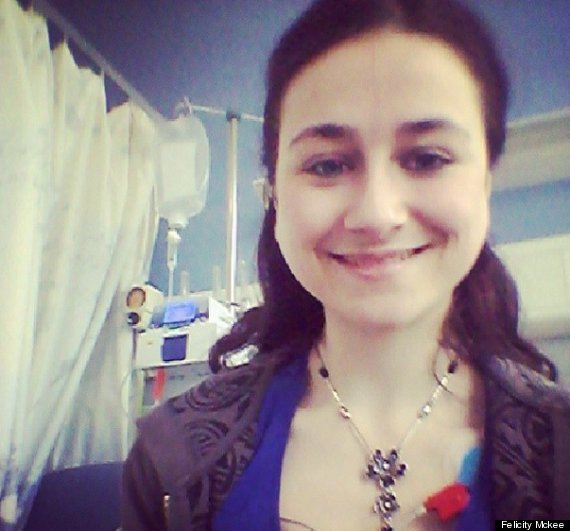
felicity mckee
Felicity during a hospital visit

It also controls where she lives - stairs are hard as the electrolyte problems cause light headedness and muscle weakness - and whom she lives with - Felicity has to make sure she is around friends who are capable of medically assisting her.
"Hospital admissions interfere with me attending university, exams and coursework," she continues. "And my disability meant I was declared unfit to work. Any job I did have wasn't always happy to accommodate taking medications or time for medical appointments."
Felicity is currently on medical leave from university for the second time, and says a big issue is people assume eating disorders are primarily about weight - when they are actually a mental health problem.
"There was definitely a level of denial as when I initially reached out for help, people would say 'don't be silly, people with eating disorders are skeletal', which is a total falsehood. Even when I was at my worst, I'd tell doctors I wasn't ill as I wasn't really skinny.
"If you aren't thin you aren't seen as ill. But my electrolytes were all over the place and on some occasions and I was at risk of heart attack or cardiac arrest. I was warned even breaking into a sweat could kill me."
Felicity used to be a regular gym goer at university and says even when her BMI was too low, she was complimented on her illness and physique.
"This only feeds the problem," she explains. "The gym certainly didn’t help, and people complimenting me wasn’t useful either. Once it became the unspoken secret around the student village, and people then used it as a reason to ask diet advice from me, as I was clearly so successful according to them.
"People still think it is a choice. One lecturer told me I chose to be in hospital."
One Priory Clinic doctor previously warned university was a breeding ground for eating disorders due to the amount of freedom and lack of a support network, which Felicity says was the case.
"I could stay away from home, and those close only saw me rarely, so it is easier to hide. People tend to label their food at uni, and I was no different, except mine was in individual portions labelled with calorie content. People assume you are just health conscious, and leave it at that.
"I think there is a general indifference, or a you brought this on yourself attitude among students.
"The issue was that when I needed help once to go to hospital, most people felt I was always in and out of hospital. Once I was left slumped in the middle of a university corridor ringing around for a lift from anyone. I managed to get a friend to go with me, even though she had to leave class and we managed a taxi to Belfast,
"On what should have been my 21st birthday, I was hardly able to walk."
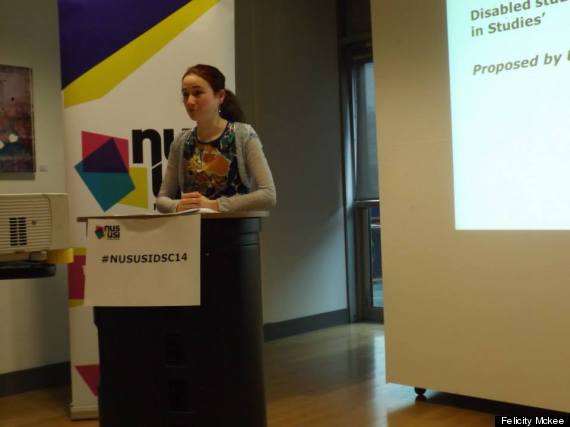
felicity
Felicity talking at an NUS event

Despite previously keeping her condition a secret, Felicity says she has opened up about her eating disorder in the hope she can escape it.
"Such secrecy only perpetuates the stigma and tightens its grip as you feel unable to speak about it. Sometimes it can be ‘visible’ but it isn’t always. By staying silent and others engaging in silence as well, it allowed me to get away with it for so long.
"Support wasn’t there for me, and so it was easier to be in the grips of this, people knew, but no-one said, it was the unspoken secret.
"Having an eating disorder is a terribly lonely place."
Although Felicity says she is very much still in the grips of the condition, she feels stable, and she is receiving medical support.
"Recovery is like a cha cha, 2 steps forward, one step back."
"But," she adds, "you are still going forward."

Friday, July 4, 2014

Kim MacKenzie, Miss Norway 2014, has teamed up with Joi Hall of Empowered by Joi and the Youth Eating Disorder Awareness, to appear at the Dying to Be Thin Red Carpet Gala in Beverly Hills on June 27

Kim MacKenzie, Miss Norway 2014 in the Queen of the Universe Pageant to speak at the Dying to Be Thin Red Carpet Gala with Joi Hall of Empowered by Joi
Kim MacKenzie, Miss Norway 2014 to speak at the Dying to Be Thin Red Carpet Gala
Kids battling eating disorders have to know that they have support. They have to feel comfortable talking about it. We hope to give them that.
Los Angeles, CA (PRWEB) June 03, 2014
According to a National Institute of Mental Health (NIMH) funded study in 2011, 3% of U.S. adolescents are affected by an eating disorder, but most do not receive treatment for their condition. Kim MacKenzie, Miss Norway 2014, who will be appearing at the Dying to Be Thin Red Carpet Gala on June 27, 2014, was a part of this percentage.
“The only help I received was from friends and family. But, if I hadn’t told them that I was battling an eating disorder, no one would have known. No one would have been able to help me,” states MacKenzie, “That’s why this gala is so important to me, because kids battling eating disorders have to know that they have support. They have to feel comfortable talking about it. We hope to give them that.”
MacKenzie is teaming up with Joi Hall, a holistic, self-empowerment youth activist, motivational speaker, wellness and lifestyle coach, radio host of “Talking with Truth,” and creator of Empowered by Joi. Together, MacKenzie and Hall will be using the Dying to Be Thin Red Carpet Gala to raise funds for Psycotherapy Plus, a 501(c)(3) non-profit, local agency that has served the Inland Empire and San Bernadino and surrounding areas since 2006. Their goal: to bring awareness about the escalation and severity of youth eating disorders amongst our children as young as second and third grade, erase the stigmas surrounding youth eating disorders such as age, gender, and ethnicity, and, show that through collaboration, there is a solution to this mental illness.
“Most people don’t categorize an eating disorder as a mental illness,” explains MacKenzie, “But it is.” In fact, according to the NIMH, a majority of youth with eating disorders also meet criteria for at least one other psychiatric disorder such as depression; and, youth with eating disorders associate with higher levels of suicidal thinking, compared to those without an eating disorder.
Dying to Be Thin Red Carpet Gala will take place on June 27, 2014 at 7:30PM at Sfixio in Beverly Hills. General admission tickets are $35. VIP tickets are $50. Tickets can be purchased on Eventbrite or on http://dyingtobethinredcarpetgala.splashthat.com/.
About Kim MacKenzie, Miss Norway 2014:
Kim MacKenzie is a Burbank-born screenwriter, producer, actress, and multi-passionate entrepreneur. Named "Pilates Pro" by Oxygen Magazine, as president and spokeswoman for The Body Archer, Kim helps millions of Americans relieve back pain with her company’s doctor-recommended back stretching chair, The Body Archer®. Nominated for three WEGO Health Activist Awards, her writing on healthy living has been featured in Spafinder Wellness 365, Classtivity, Become Natural, Hearts of Gold, and The Care Co. Kim has also permeated the entertainment industry as a screenwriter, actress, and producer. Her film BRO’ starring Danny Trejo was distributed by Lionsgate in December 2012. As Miss Norway 2014 in the Queen of the Universe Pageant, Kim is sponsored by Rock’s Tree and Hillside Service, The Body Archer, and “Confessions of a Woman” series author, Isabell Wells. Kim’s mission is to combine health and entertainment, inspiring people to live healthy, well-balanced, abundant lives.
About Joi Hall, Empowered by Joi:
Joi Hall is the founder of "Empowered By Joi". She is a self empowerment youth activist, motivational speaker, and soon to be author who has appeared on The Fox Morning Show, The Sheryl Lee Ralph Radio Show, and and has spoken at church organizations, youth events, and various organizations about natural health and family life, mindset reformation for success, and entrepreneurship. She uses insights from her background as a young entrepreneur, success coach, and chronic disease warrior to create personal and captivating presentations that inspire results. As a young mother of 3 children, she is dedicated to creating a movement of empowering and transforming the lives of our youth, and communities from a holistic perspective through self development, health and wellness initiatives, community involvement, and leadership. She is a true asset to youth organizations that want to increase productivity, morale and the health of their youth. http://www.empoweredbyjoi.com.

If you or someone you love has an eating disorder, or struggles with body image, please call us at Ramey Nutrition (206) 909-8022 or visit us at www.rameynutrition.com

Friday, June 27, 2014

Plus Sized Images Can Change Body Size Preferences

     Eating disorder professionals and advocates have long discussed the effect of the 'thin-ideal' on body-image and self-esteem.  Westerners see an average of 2,000 images in advertising alone, on a daily basis, and images of thin bodies far outweigh the number of normal and plus-size bodies seen in the media.  There have been multiple studies on how this may play into the creation of eating disorders and how it affects the self-image of people who don't have eating disorders.
Interestingly, there is new research that society's preference for small bodies could be changed by viewing more images of plus-size models. 
     A study done recently at Durham University in the United Kingdom, showed women images of both slim bodies and plus-sized bodies. When shown the photographs of the plus-sized models in 'aspirational' settings (such as a beauty product or fashion advertisement), the preferences of the women being surveyed changed.
     Although it is unknown if viewing larger people would change preferences long-term, it is an important finding and one that encourages fashion designers and magazines to continue to increase the number of plus and normal sized women who are featured on their pages and in their shows.
What do you think of this study's results?  Do you think that viewing more normal and/or plus-sized women would change your preferences?

If you or someone you love has body image issues, please call Ramey Nutrition at (206) 909-8022, or visit us at www.rameynutrition.com

Friday, June 20, 2014

A new breed of eating disorder that couples starvation diets with excessive alcohol consumption is sweeping through college campuses, affecting scores of young women, experts say. To avoid gaining weight, the coeds devote their calories to the booze.

This condition is blurring the line between eating disorder and substance abuse, making it particularly dangerous, and many young women find themselves developing these habits once they head off to college.
ALCOHOLIG2
Jamie Selfrige, an occupation therapy student at the University of Illinois at Chicago, found herself and her friends falling into a pattern of skipping meals followed by heavy drinking while she was an undergraduate student.

“We wouldn’t eat dinner,” Selfrige said, now a graduate student for whom the problem faded away by senior year. “We would save up all of our calories for drinking.”

Part of the problem is how heavily girls influence their other friends. What starts out as a problem for just a couple of girls can quickly spread to an entire peer group.

“If they’re gonna skip a meal, then I’m gonna skip a meal because I don’t want to be the fatty," Selfrige said.

Niquie Dworkin, coordinator of clinical training at Lakeview Center for Psychotherapy, has worked for more than 20 years with people who suffer from eating disorders as well as those who struggle with substance abuse.

“I think most people probably fall into a category of disordered eating,” Dworkin said. “They might not have an eating disorder proper, but they might exhibit some of the symptoms.”

These negative feelings towards foods and the knowledge that alcohol contains a lot of calories makes the problem even worse for women trying to limit their calorie intake.

Allison Chaplin, a nursing student at DePaul University, began to notice one of her friends developing this habit while in college and it seems to be getting worse.

“She literally will not eat during the day and then she’ll drink,” Chaplin said.

The pressure to be skinny is evident in every magazine, movie and television show and girls are well aware of that pressure early on.

“Thin is what’s beautiful,” Selfrige said.

As girls get older and head off to school, the need to stay thin is complicated by the pressure to fit in as a college student by partying and drinking.

“It’s just part of the college lifestyle,” Selfrige said.

Chaplin chocks it up to “a fear of missing out.”

While most young people see college as a gateway to independence, it also creates an environment that contributes to eating disorders and substance abuse since starting college is such a huge lifestyle change.

College is “the first time that most of these people have been away from their parents, so whatever sort of ways their parents were helping them stay on track or be moderate, they don’t have that anymore,” Dworkin said.

Additionally, their age puts them at a particularly high risk to develop problems with alcohol and eating, though eating disorders can occur with or without substance abuse.

“Young people, when they’re 18, 19, 20, you know, their brains are still developing,” Dworkin explained. “They don’t have as much capacity to weigh it and think things through, so they’re more vulnerable.”

There may be another, newer explanation, though, and it comes from something most young people use every day. Pamela Keel, professor of psychology at Florida State University, conducted a study that identified a link between Facebook use and the risk of developing an eating disorder.

Keel has spent her career teaching and researching factors that contribute to eating disorders and negative body image. Two of her students approached her about doing a study when they realized that the popular social media sight might be influencing young women’s attitudes about their bodies.

“More time on Facebook is associated with disordered eating,” Keel said. Facebook reinforced a poor self-image as young women looked at and compared themselves to the glamorous shots of others.

The study had two parts. The first part was a survey where women reported the how frequently they used Facebook and their attitudes towards eating, looking for some sort of link. The second part questioned whether Facebook use caused these attitudes or just correlated with them. Keel set up an experiment where women were called in to spend either 20 minutes on Facebook or 20 minutes reading a Wikipedia article. The women who spent time of Facebook found it contributed to increased anxiety over weight and body image compared to those who read the Wikipedia article.

Keel explained that Facebook is unique compared to other websites because it brings together peer pressure and media in the same place.

Facebook “basically combines these two known risk factors,” Keel said. The study was published in the International Journal of Eating Disorders.

Restricting calories wreaks havoc on the body, but just how harmful is it and what is affected?

Severely restricted diets and alcohol abuse impair the brain in similar ways, according to Dr. David Hamilton, a psychiatrist specializing in neuroscience and the associate medical director of Yellowbrick, an addiction treatment facility in Evanston. His training in neurology give him an understanding of how different substances impact brain function.

He explains that starvation impairs certain parts of the brain.

“The brain has developed mechanisms for dealing with that and it starts selectively shutting down parts that aren’t as necessary as other parts,” Hamilton said. “And those parts are things like reason, decision-making, consciousness.”

The way alcohol interacts with the brain is strikingly similar, gradually impairing function. Combining food restriction with drinking is even worse because it magnifies the effects on the brain, which can be dangerous and even deadly for young women.

“They’re more vulnerable to traumatic assault, accidents, drinking more than they intended to, using other substances they might not have decided to if this issue, this decision making part of the brain, was working more properly,” Hamilton said.

Unfortunately, what starts out as a minor problem for some women turns into a huge one later down the road. This is what Chaplin sees happening to her friend.

“It’s kind of taking over her life now,” she said.

While some young women spiral out of control, others find they are able to correct the problem as they grow older and leave the college lifestyle behind.

“It slowly started to taper off senior year,” Selfrige says.

Selfrige has not had any problems since she graduated from college, suggesting that the condition may be a phase that other college women will be able to outgrow.
 
If you or a loved one struggles with an eating disorder or disordered eating, please call Ramey Nutrition at (206) 909-8022 or visit us at www.rameynutrition.com

Wednesday, June 18, 2014

Serious Concerns over Eating Disorders among Australian Men by Markus Vogl


Thousands of Aussie men are suffering from eating disorders. Most of the times, men do not get noticed as they do not take treatment fearing the stigma attached with the condition.

Christine Morgan, CEO of the Butterfly Foundation, an organization for people with body image issues, said 40% of people having binge eating disorder and 20% of people having anorexia nervosa are men. As per the foundation, over 333,000 Australian men currently have a clinical eating disorder.

There is a notion that eating disorders can only happen among teenage girls, but it is not the truth, said Morgan. If people would get to know about the number of boys getting hospitalized due to an eating disorder then they will get shocked, affirmed Morgan.

Some of the biggest names of the entertainment industry have battled with eating disorders. Comedian Russell Brand developed bulimia as a teen. Former Silverchair frontman Daniel Johns suffered with anorexia at the time when he was at the peak of his career.

Eating disorder covers a number of illnesses including anorexia nervosa, bulimia nervosa, binge eating disorder, and atypical presentation. Main problem among boys is they do not seek treatment as often as women do.

"It's perceived as a sign of weakness. They believe it's simply a matter of willpower - but an eating disorder is not cured by willpower. It's a very serious psychological disorder", stated Morgan.

Male eating disorders can go unnoticed. Men can start with disordered exercise behaviours that lead to disordered eating behaviours.

Tuesday, June 17, 2014

WHEN we discuss eating disorders, the conversation usually revolves around teenage girls and young women.
But thousands of Aussie men are suffering from eating disorders and failing to seek treatment for fear of the stigma still attached to the illness.
A staggering 40 per cent of people with a binge eating disorder and 20 per cent of those with anorexia nervosa are men, says Christine Morgan, who is the CEO of the Butterfly Foundation, an organisation for people with body image issues.
The Foundation estimates more than 333,000 Australian men currently have a clinical eating disorder.
“There’s this myth that eating disorders are something that only affects teenage girls, and that couldn’t be further from the truth,” Ms Morgan told news.com.au.
“The number of boys that are being hospitalised (because of an eating disorder) is frightening stuff.”
Silverchair frontman Daniel Johns has been very open about his struggle with anorexia.
Silverchair frontman Daniel Johns has been very open about his struggle with anorexia. Source: News Limited
Some of the entertainment industry’s biggest male stars have battled with eating disorders. Elton John says he developed a “camaraderie” with Princess Diana over their shared illness, bulimia. Comedian Russell Brand also developed bulimia as a teen, which returned when he was in rehab for a drug and alcohol addiction.Former Silverchair frontman Daniel Johns suffered from anorexia at the height of his career, even penning Ana’s Song (Open Fire), about his battle.
He told Andrew Denton’s Enough Rope program: “I could somehow convince myself that apples contained razorblades and wouldn’t go to restaurants because I thought every chef in the world wanted to poison me.”
Tony Kay, 29, has battled anorexia nervosa since he was a teenager.
Tony Kay, 29, has battled anorexia nervosa since he was a teenager. Source: Supplied
Eating disorders cover a broad spectrum of illnesses — anorexia nervosa, bulimia nervosa, binge eating disorder, and atypical presentation (where a sufferer has clusters of symptoms from all three of these illnesses) are all types of eating disorders.
Exacerbating the problem is that men are far less likely than women to seek treatment.
“Guys are more likely to say, ‘I don’t really have a problem, I don’t really need help’,” said Ms Morgan.
“It’s perceived as a sign of weakness. They believe it’s simply a matter of willpower — but an eating disorder is not cured by willpower. It’s a very serious psychological disorder where the battle ground is in the brain.”
Tony Kay knows this battle all too well. The 29-year-old Sydney man has struggled with anorexia since he was a teenager.
“When I was 13, I was very conscious of my body and was always comparing and contrasting myself to other boys,” Mr Kay told news.com.au.
Tony has been hospitalised four times.
Tony has been hospitalised four times. Source: Supplied
“When I finished high school, I had a lot of spare time on my hands and I put on a lot of weight quickly because I was sitting at home doing nothing. I weighed 120kg.
“I had a lot of body dissatisfaction and I decided to lose a bit of weight to feel better about myself.
“But it went from being this hobby or a goal to be healthier, to several months on having noticeable signs of an eating disorder.
“I was restricting food and exercising compulsively. I was going to the bathroom often to flush out any waste. Obviously I lost weight and that positive reinforcement exacerbated it.”
Mr Kay says he’s hit rock bottom “several times” and dropped to an extremely low weight (I’m 6”3. I was a noticeable anorexic”). He has been hospitalised four times.
“I could no longer really function,” he said.
“I couldn’t feel anything. I wasn’t happy, I was apathetic, I was tired. I didn’t have any energy and I was very angry. The only thing that made me feel any better was exercising and restricting food, because it gave me a sense of security.”
And while his condition has improved, Mr Kay says you never fully ‘recover’ from an eating disorder.
Tony (right) and friends.
Tony (right) and friends. Source: Supplied
“It’s a day by day thing,” he said. “One day I will challenge those thoughts and unrealistic expectations and eat freely without consideration.
“Other days, I’m a slave to those thoughts. It becomes so ingrained in you it’s hard to stop.”
Male eating disorders can easily go unnoticed. Going to the gym daily or watching what you eat can be misinterpreted as simply going on a health kick.
Ms Morgan says: “They will often start to engage in disordered exercise behaviours which then leads to disorder eating behaviours, with the idea of getting that buff, ripped look, which society says is a healthy look, that it’s a healthy practice.
“How few guys naturally have that ideal body look? To try and get that look they have to do things which are very harmful to our bodies.”
Mr Kay says eating disorders are more rife in the male community than people realise.
“Images of the ideal male are constantly shoved down your throat,” he said. “They’re unrealistic expectations. Most people can never achieve that.”

Saturday, June 14, 2014

Diabulimia: A Growing Issue Ramey Nutrition is Attacking


SHE was a typical headstrong teenager who dreamed of a life in the limelight. Despite a diabetes diagnosis at seven years old, Sarah Caltieri refused to let anything derail her singing ambitions – not even a life-threatening illness.

But as a high school student she had no idea the result of youthful stubbornness would ultimately leave her blind.

Fixated on her goal of “making it” in showbiz, the talented vocalist began skipping insulin shots in a bid to lose weight.

“Eventually there were periods of time where I didn’t inject insulin at all and could lose up to half a stone a day,” said Sarah, now 34. Just as most of her friends were graduating university, the consequences of Sarah’s teenage rebellion came back to haunt her, with tests revealing damage to her kidneys and eyes.

Before surgery could be scheduled she lost her sight aged 22 – both eyes in less than a week.

A decade on, Sarah has beaten all the odds to make good on her childhood dreams and hopes her new album launch will raise awareness of her condition. She is collaborating with producer Duncan Cameron and hopes to complete her debut record in the comings months before a setting off on whirlwind tour across Scotland and the UK.

But Sarah, who lives in Leith, will never shirk her determination to highlight the dangers of the little-knowndiabetic eating disorder that changed her life but remains unnamed.

At seven, Sarah fell into a diabetic coma that nearly killed her. Doctors told her parents – who kept vigil at her bedside – that her life hanged in the 
balance.

After two never-ending days, she came to. Sarah was packed off home with a Type 1 diabetes diagnosis, diet sheets, needles and strict instructions not to eat sugary foods.

With her body unable to create insulin – needed for the body to absorb enough glucose from the blood to create energy – the youngster would have to rely on injections for the rest of her life. Her childhood would now be regimented by a host of rules of set meal times, weighing food portions and avoiding sweets.

“It was a struggle to get it under control when I first came out of hospital,” she said.

“As a child I felt quite isolated when I was the only one who wasn’t allowed birthday cake or sweets at parties.”

She kept on top of her medication but the pressures of high school meant the rebellious teenager was lurking just around the corner. Like many girls her age, Sarah began flirting with alcohol and cigarettes which would send her blood glucose levels soaring.

But as performing became more of a career aspiration, she also became more body-conscious. She started fixating on what she was eating and her size, and went from a “healthy weight” to seriously ill.

“I became obsessed with body image and just became a teenager. With my hormones all over the place, and having to control diabetes and teenage life, unfortunately I started to develop symptoms of anorexia,” she said.

“I started dieting and losing weight. I lost a stone healthily but didn’t stop and was obsessively exercising, then the binges started. Eventually I figured out how to manipulate my insulin and realised that if I stopped taking it, food would go straight through me.”

Aged 17, she reduced her prescribed five injections a day to just one every few days.

Depleted insulin levels meant what little she did eat couldn’t properly be broken down, leading to dangerously steep weight loss.

“I was completely oblivious to the damage I was doing to my body. My blood sugars were off the scale. I was a walking zombie, I could barely function.

“I was good at hiding it from my family, I just pretended my blood sugar was too high. Really what I was doing was killing myself.

“With an eating disorder, all you’re interested in is losing weight, the consequences don’t even register. It’s a mental illness but no-one recognised it.”

Sarah’s education suffered and her life-long dreams of making it to drama school fell by the wayside as she struggled to get by each day.

After months of declining health, she visited a clinic before her GP eventually referred her to psychologist to “unravel the mess”. She re-learned old habits. She learned how to be diabetic again.

A few years later, well down the road to recovery, she received bombshell news that her kidneys and eyes had been damaged. Sarah was diagnosed with diabetic retinopathy in both eyes – extra blood vessels that grow because of poor blood flow in the existing ones.

Before she could undergo surgery, her left eye haemorrhaged. Doctors hoped to save the other but within four days the right eye followed and Sarah lost her vision. “I lost it all in just under a week,” she said. “It was absolutely horrendous. I put myself through all of that and now I’ve gone blind. I just thought I don’t know if I can live.

“I lost my job, my driving licence, everything I’d ever known, I had to start from scratch again. It was like learning walk again. I had to learn how to go out using a cane, be independent. The main thing I had to re-learn was confidence. It’s scary being out in the big wide world with no vision.”

About a year later, while she was still undergoing operations, she was told about a part in a play and decided to audition in her home town of Leeds. She landed the lead role and has “never looked back”, moving to the Capital five years ago after falling in love with the city.

Sarah made her professional début in the stage musical The Threepenny Opera and has since appeared in numerous plays – including some on the Fringe – but this will be her first studio album. “It has always been a dream of mine,” she said of the album. “A lot of the songs on there, I wrote a few years ago, They are quite autobiographical and tell my story.”

She wants to use her plight as a way of highlighting the condition and does a lot of work for Scottish charity Diabetics With Eating Disorders.

Sarah relentlessly campaigns for her condition to be properly recognised, with the backing of blind MSP Dennis Robertson.

“This eating disorder has not been given a proper diagnosis or name by the medical profession but sadly it is a worldwide thing,” she said. “Without this, it’s really difficult to try and raise awareness of it and get people to listen. We need funding from the government to train people to know how to deal with it and for special clinics to be opened.

“It’s as huge as anorexia or bulimia but because it’s not been given an official name, people don’t hear about it.

“Without a shadow of a doubt, my blindness was down to the diabetic eating disorder. I feel like I’m very lucky to come through what I have done. I’m a very happy person now and I feel like I need to help other people in any way I can. There is light at the end of the tunnel, it’s a lot of hard work but you can get through it.”

If you or someone you love struggles with an eating disorder and diabetes please call Ramey Nutrition at 206-909-8022 or visit us at www.rameynutrition.com